
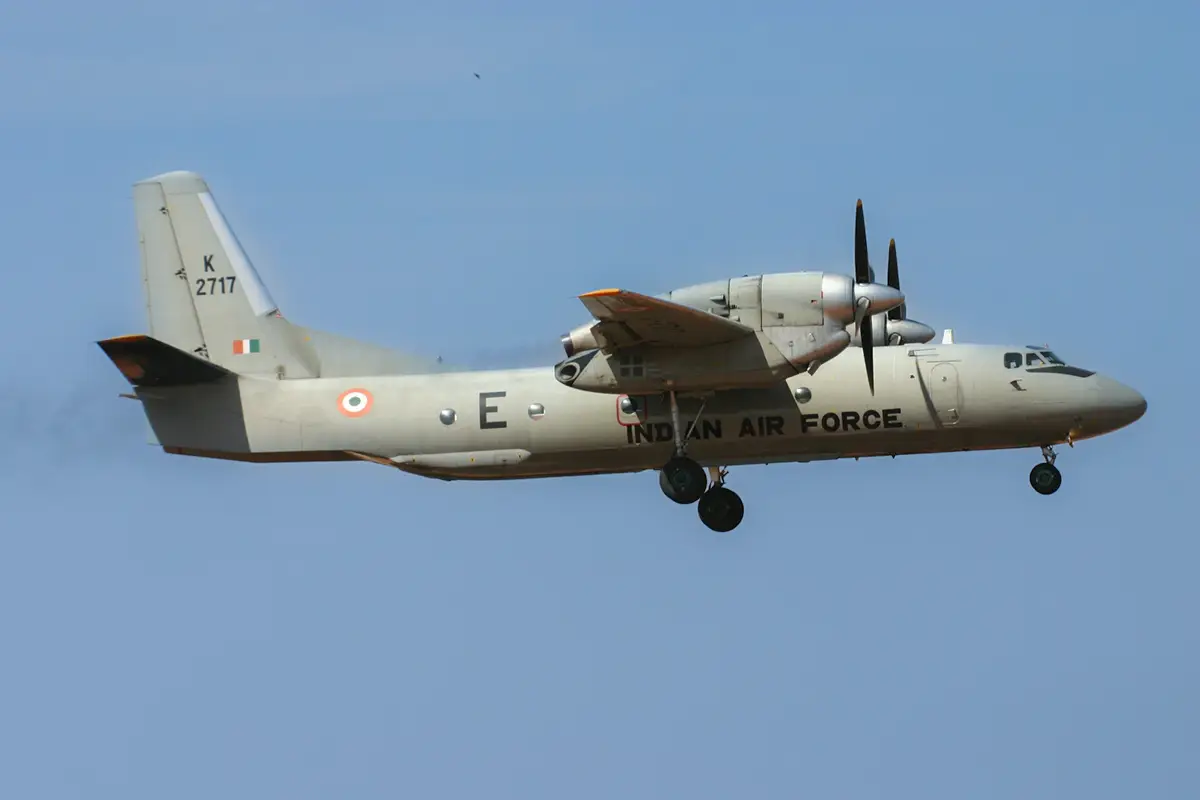
In Feb 1984 Air Hq detailed me as the team leader for the AN-32 induction trials. I had Gp Capt 'Dada' Ghosh (79PC), Bandi Sundar and two Army officers in the team of ten. Dada and Bandi had completed their conversion trg in Kiev while I had not even seen the aircraft. An earlier evaluation by Wg Cdr Ajit Lamba in 1976 had found bad stalling characteristics and inadequate short field performance. I decided to do a quick famil on the aircraft and do only the handling quality checks at the stall and during critical engine failure on rotation. I requested Dada and Bandi to do all the mission oriented flying as they were more qualified than I was.
The Antonov Desgn Bureau team had three test pilots Vladimir Kurlin, Katchiencko and Risnitski from their certification agency. There was also a navigator and some maintenance personnel. Their leader was a senior designer. They arrived in Delhi with two brand new aircraft, one of which was packed with instrumentation. The aircraft had two AI-20D engined rated at 5180 shp each. After the initial meeting at VB where the Soviets were ordered to give me familiarisation training we moved to Agra. I did two famil sorties, some C&L and did the stall checks in a number of configurations and flight conditions. There was an Antonov tp in the right seat always. The stall tests were satisfactory. Then I sat on the left seat and asked the tp on the right to feather the critical engine at VR. At take of point I announced on R/T we would be feathering an engine at VR. The ATC thought we were mad. Controllability required a boot full of rudder and half wheel deflection towards the live engine. SE performance was satisfactory.
After a para dropping demo at Agra, Kurlin (and Dada) did a demo flight. He approached from the right at 500 ft AGL with the left engine feathered, did a right tear drop turn and when we saw him come from the left his right engine was feathered. Then he disappeared, reappeared at high speed at about 1500 ft AGL and did a full barrel roll. He pitched the nose 30 deg above the horizon, rolled past the inverted position and levelled out on the horizon. It took a few seconds for our open mouths to close!
Then we moved to Jorhat for the ALG landings and supply drop tests. I left the drop sorties to Dada and Bandi while Kurlin and I concentrated on the landings. Mechuka and Tuting did not pose any difficulty.
Walong was a 800 yard dirt strip oriented 02/20(?) with the Lohit river valley to the north and east and a 600 ft high hillock at the southern end. Otters and Caribous would land 02 and take off 20 turn left, drop into the Lohit valley and fly away. Kurlin did several dummy approaches from either side and we realised it was not possible to imitate the Caribous and Otters. We went back to Jorhat and I was ready to call off the landing test but not Kurlin. He took it as a personal challenge and said he would land 20 and take off 02! I made it clear to the Antonov team that this landing was NOT an IAF requirement. Before take off early next morning I received a message from the AOC Air Cmde Kanaghat that 'C in C' East AM PP Singh had said no chances were to be taken. We set off with an empty aircraft, only 4 tons of fuel, Kurlin in the left seat, Dada on the right, I in the jump seat and the navigator at his station. Kurlin made three approaches from the NW following the river valley on a heading of approx 120, turning right on to 20 and dropping down on the strip. When he was confident of pulling it off we got ready for the actual landing. He came down the valley lined up with the strip and at round off height he unlocked the props. The aircraft hit the ground with a terrific bang, Kurlin braked hard and we stopped well before the end of the strip. He turned around, switched off and we got out to be received by a troop of Gurkhas. They presented him a kukri and tea was served. I was watching the wind sock with great concern because it was no longer limp and we would be taking off downwind. Kurlin was lapping up all the attention he was getting and was unfazed when I told him to hurry up. He started up, taxied to the base of the hillock and lined up for take off. A rock cliff on the edge of the north bank of the river faced us. Kurlin started the take off roll. The roar of the engines was mixed with the staccato rattle of stones peppering the belly like machine gun fire. I stared at the ASI waiting for VR of 190 kmph. Just as we hit 190 Kurlin went to flaps 30 from 15, the strip ended and we appeared to fall into the valley. Kurlin retracted the gear. The aircraft lurched into the air and now two things happened simultaneously. Old Newton was pulling us down to the river and the cliff face was rushing towards us at menacing speed. Just when I thought all was lost Kurlin put on what appeared to be 90 deg bank to the left but could not have been more than 20 deg. For long seconds the aircraft seemed to hang in the air, held aloft only by the immense power of the two Ivchenkos. As he lined up with the valley he took off bank, the fight between Ivchenko and Newton ended and the aircraft started accelerating. At 240 kmph he cleaned up the aircraft and we climbed away. I stood up to check the seat of my flying overall (!!!) and Dada informed Jorhat we were airborne from Walong. The sigh of relief could be heard whistling down the valley from Jorhat to Shillong.
It was a masterly display of piloting skill, confidence in the aircraft and knowledge of performance. I had never seen anything like that before nor have I since.